Bringing Low-Volume Injection Moulding In House — A Pneumatic Benchtop Machine and a Hand-Cut Aluminium Mould
In one line
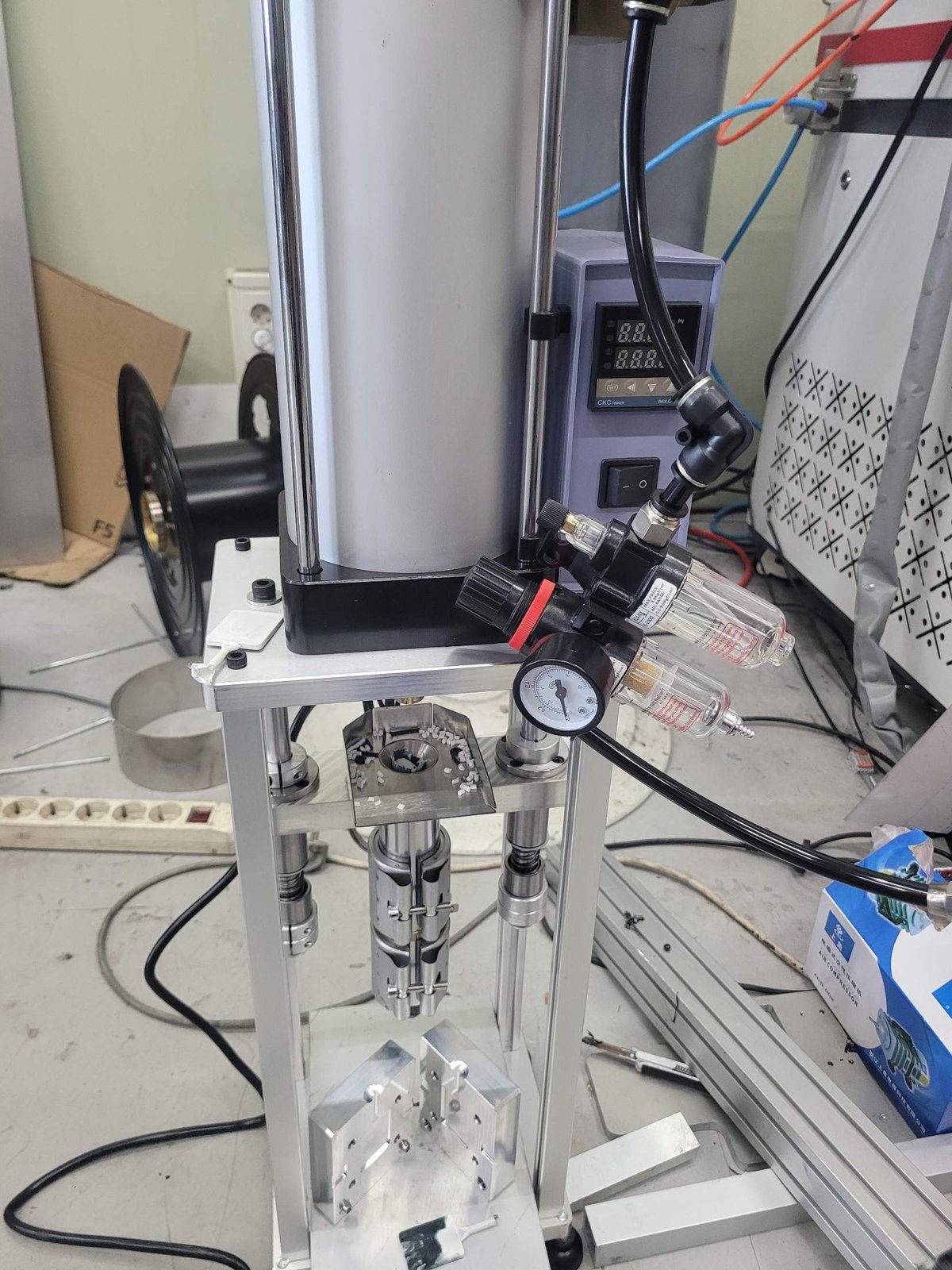
Nobody wanted our 100-piece and 500-piece moulding jobs. So we built a pneumatic benchtop moulding machine around a hand-cut aluminium two-plate mould and brought the work in house. This is the record up to the first successful shot.
Why build it ourselves
The enquiries kept arriving and we kept turning them away.
“Could you mould 100 of these?” There was no way to serve that. A production moulder’s minimum is typically thousands to tens of thousands of pieces. Without existing tooling, the mould alone costs thousands of dollars, and dividing that across 100 parts gives a per-piece price nobody will pay. The moulder has no reason to take it and the customer has no reason to accept it.
So the work goes to 3D printing instead. Poyutech runs a printing service, so recommending that is easy. But the same cases kept failing there.
- Parts that need interlaminar strength — printed parts split along the layer direction
- Parts that must be validated in the production resin — the flexibility of PP or the impact strength of ABS cannot be reproduced by printing
- Parts where surface finish is the product — post-processing still does not give a moulded face
- Parts in the 300-piece range — printing cost overtakes the tooling cost
Leaving that band empty was a waste. We have CNC machines in the building, people who can cut metal, and a history of building control systems. Cutting our own moulds and setting up our own machine was simply work to be done.
Machine configuration
A Chinese pneumatic benchtop moulding machine. Pneumatic rather than hydraulic, so an air compressor is all it needs.
| Item | Specification |
|---|---|
| Drive | Pneumatic cylinder, compressor fed |
| Shot capacity | 30 g |
| Nozzle | Ø4 mm bore, Ø10 mm outside, spherical tip |
| Heating | Two band heaters, independently controlled zones |
| Temperature control | Two REX-C series PID controllers |
| Air | Two-stage filter plus regulator |
| Installation | Benchtop, single-phase 230 V |
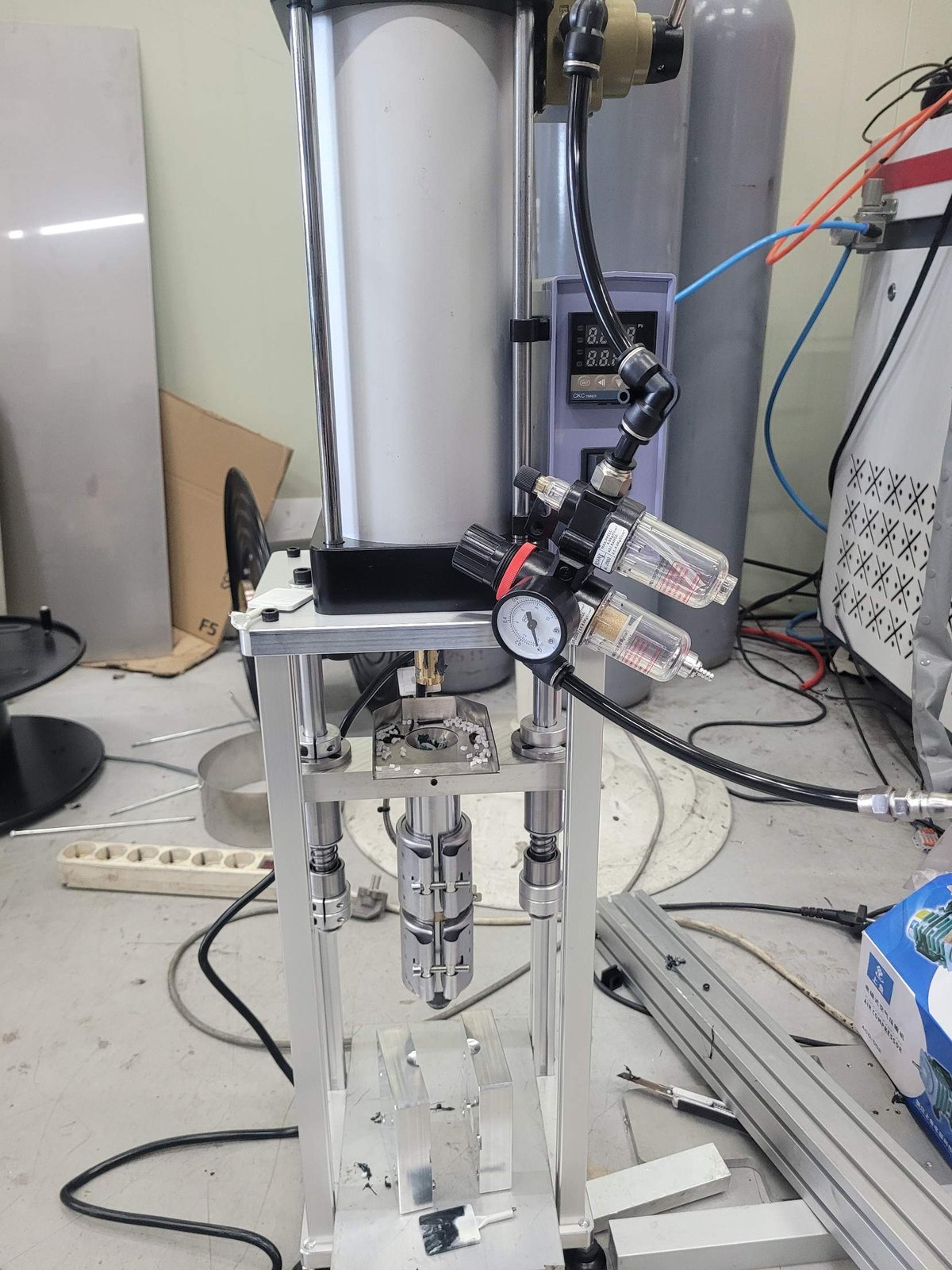
Splitting temperature control across two zones is the important part. Hold the whole barrel at one temperature and pellets soften and bridge at the feed throat while under-melted material reaches the nozzle. The hopper end has to run cooler and the nozzle end hotter.
The air side gets a two-stage filter. Moisture and oil carried over from the compressor make cylinder force vary shot to shot. Lose shot repeatability on a low-volume job and three parts in ten come out short.
We cut the mould ourselves
Two-plate, aluminium, cut on our own CNC.
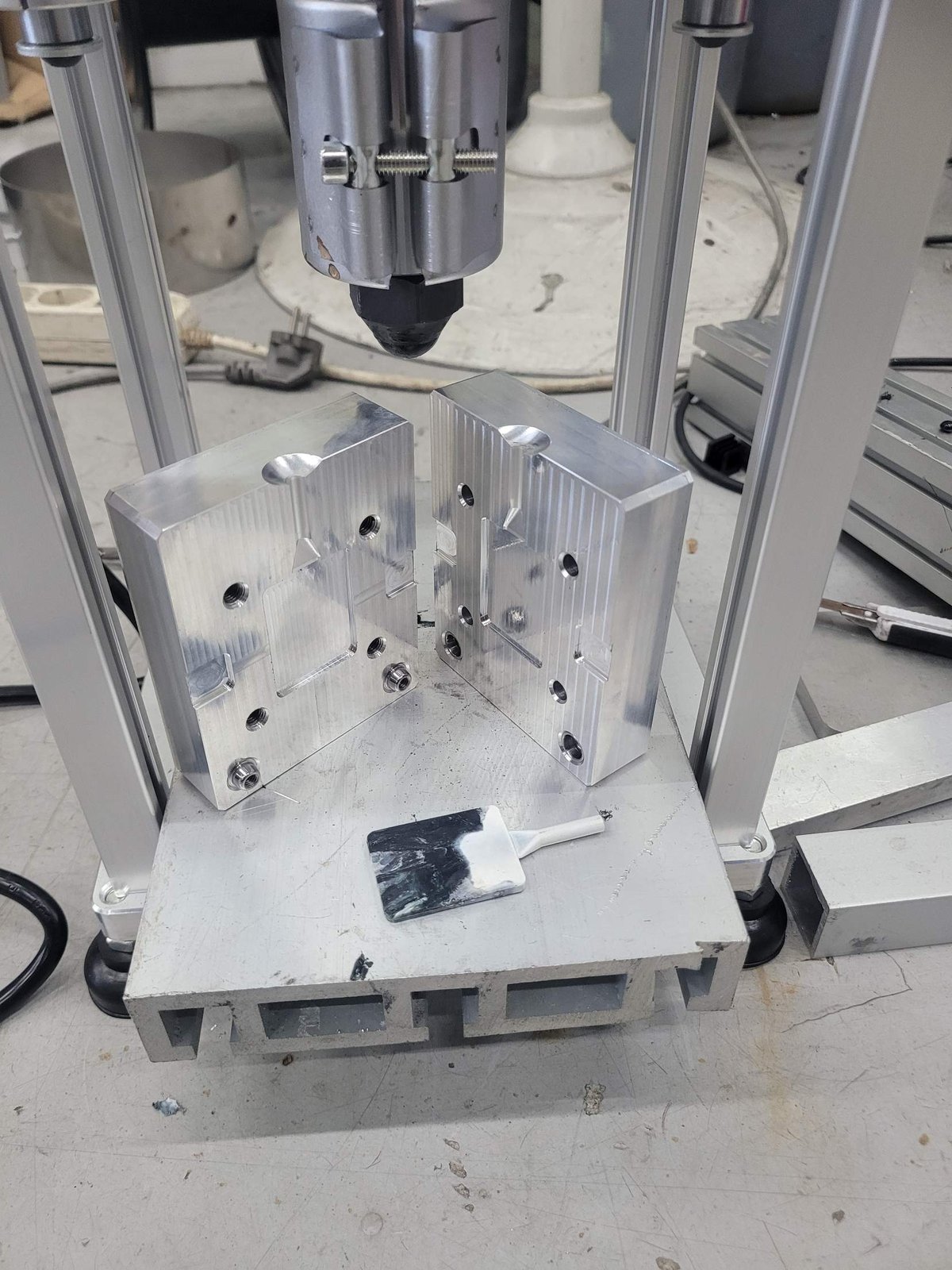
The photograph shows the parting face opened up — cavity, runner and V gate all visible. The black-and-white marbled part in front is the first piece out of the mould. The mixed colour is residual resin left in the barrel; a few more purge shots bring it to a single colour.
On 15 October 2026, the first shot came out whole.
The judgement calls
Only what would be useful to somebody weighing the same decisions. Jump to the heading that matches your case.
When no moulder will take your 100-piece job
The situation — Prototype validation is finished and you need a short production run, but moulders ask you to raise the quantity and tooling quotes come back in the thousands.
Why — It is their cost structure. Mounting a mould and dialling in conditions takes half a day whether you then run 1,000 parts or 100,000. At low quantities, the per-piece number simply does not work. The moulder is not being unhelpful; the arithmetic is.
The alternative — Make the mould light. Aluminium instead of steel, two plates instead of three, manual ejection instead of automatic, a cold runner instead of a hot one. You give up tool life and cycle time, and tooling cost drops by an order of magnitude. Below 1,000 pieces, everything you gave up was something you did not need.
3D printing or moulding?
On cost alone, the crossover sits around 200 pieces.
| Assumption | Value |
|---|---|
| Rapid tooling | USD 700 |
| 3D printing, per piece | USD 3.50 |
| Moulding, per piece (material + processing) | USD 0.35 |
| Break-even | about 220 pieces |
The formula is tooling ÷ (print price − mould price). A larger part raises the print price and pulls the crossover down; a complex mould pushes it up.
But material often matters more than quantity. If the point is validation, the part has to be in the production resin for the validation to mean anything. A drop test passed in a printing resin has to be run again on moulded parts. On that basis even 50 pieces belong in a mould.
Conversely, if you are still confirming geometry, there is no reason to mould. Once a mould is cut, changing the shape gets expensive. Settle dimensions and fit over a few printed iterations first, then cut the tool.
Is aluminium acceptable for a mould?
At low volume, yes.
| Aluminium | Steel (P20, NAK80) | |
|---|---|---|
| Machining speed | Fast | Slow |
| Tool life | Thousands of shots | Hundreds of thousands |
| Thermal conductivity | High — short cycles | Moderate |
| Modification | Easy | Hard |
| Cost | Low | High |
The thermal conductivity matters more than people expect. Aluminium cools quickly, which shortens the cycle — enough to run on natural cooling with no water lines at all. On a benchtop setup that is decisive.
A few thousand shots is a non-issue below 1,000 pieces. If the geometry has thin ribs or a deep core, that feature wears first, so put a steel insert just there. Re-cut in steel once volume is confirmed, by which point the quantity supports the tooling cost.
Where to put the gate on a two-plate mould
This mould uses a V gate — a vee milled into the parting face carrying melt from runner to cavity.
Why a vee — one end mill pass cuts it, and gate cross-section is set by groove depth. With two-plate manual ejection you clip the gate off with nippers anyway, so a precise gate geometry buys nothing.
Three rules for gate position.
- Feed into the thick section. Filling from thin to thick starves the thick region and leaves sink marks.
- Keep off cosmetic faces. The gate leaves a cut mark. Put it on a back face or somewhere the assembly hides.
- Keep the flow length short. A pneumatic machine does not reach hydraulic pressures, so a long flow path will not fill out.
The Ø4 mm nozzle bore is a constraint. On a small part it is oversized, which makes the runner and gate large and the removal mark correspondingly visible. A multi-cavity layout — several small parts on one shot — suits it better.
What a pneumatic benchtop machine can and cannot do
Written plainly. Taking on work that then cannot be delivered costs both sides.
It can do
- Parts within a 30 g shot — total including the runner
- Commodity resins — PP, PE, ABS, PS
- Quantities up to about 1,000
- Tolerances in the ±0.1 mm range
- Geometry that releases on a simple two-plate split
It cannot do
- Parts over 30 g — the shot capacity is the limit
- Engineering plastics — PC, PA and POM need temperatures and pressures beyond this machine
- Undercuts — once a slide core is involved it is no longer rapid tooling
- Insert moulding or two-shot moulding
- ±0.02 mm precision work
- Thousands of pieces a day — manual ejection makes the cycle slow
Can you do silicone moulds too?
Yes — but vacuum casting (RTV) and silicone injection are different processes and worth separating.
- Vacuum casting — two-part silicone poured into a mould and cured. Tens of pieces; the mould itself is silicone or resin.
- Silicone injection — LSR or HTV injected into a mould and cross-linked. Hundreds to thousands of pieces; the mould is metal.
What Poyutech is preparing is the injection route. The mould construction resembles thermoplastic tooling, but because curing is thermal the mould temperature requirement is inverted: thermoplastics are frozen in a cool mould, silicone is cross-linked in a hot one.
Where this stands, and what is in preparation
Available now
- Geometry review and a feasibility verdict — send a 3D file and we will say
- Aluminium rapid-tooling design and machining
- Low-volume moulding of commodity resins within 30 g
- A two-stage route: print first to confirm, then move to the mould
In preparation
- A universal mould base with swappable inserts — 80 × 100 mm. Sharing the base and changing only the cavity insert takes tooling cost down further. We are aiming at under about USD 700 for a two-cavity set.
- A library of per-resin moulding conditions — accumulating shot parameters for PP, ABS and PS
- A silicone injection tooling line
This capability is at the first-successful-shot stage. It is not a service we have been running for years. So when you contact us, we will tell you what is feasible and what is not before anything else. Taking on something unachievable and then missing the delivery date is the worst outcome for everyone.
About Poyutech
Poyutech is a smart manufacturing company based in the Gyeyang Knowledge Industry Center, Incheon, South Korea. We handle mechanical design, control design, precision machining, and prototype fabrication under one roof.
- 9 registered patents
- Registered on Korea’s public procurement channels (Nara Jangteo, S2B) — schools and public institutions can purchase directly
- Own products: laser marking systems (Poyumark), browser-based CAM software (PoyuCAM), 3D printing services (3D4U)
- In-house CNC machining, 3D printing, and laser processing
We are a three-person company, which means the principal engineer designs the part and answers the phone. There is no sales layer in between.
Mould cutting and moulding happen in the same building. Subcontracted tooling means a round trip every time conditions do not come out right; in one place, we modify it that day and shoot again that day.
What you can hand us
| Scope | Contents |
|---|---|
| Low-volume moulding | Commodity resins within 30 g, up to ~1,000 pieces |
| Rapid tooling | Aluminium two-plate design and machining |
| 3D printing | Geometry validation and dimensional checks |
| Precision machining | 3-axis CNC, jigs and one-off parts |
| Feasibility review | Just the verdict on mouldability and tooling approach |
No drawing is required. Photographs, rough dimensions, the quantity you need and the resin you want are enough for us to tell you whether it is feasible.
Contact
- Email — 3d4utech@naver.com
- Phone — +82-70-7510-4839
- Address — Gyeyang Knowledge Industry Center #313, Incheon, South Korea